


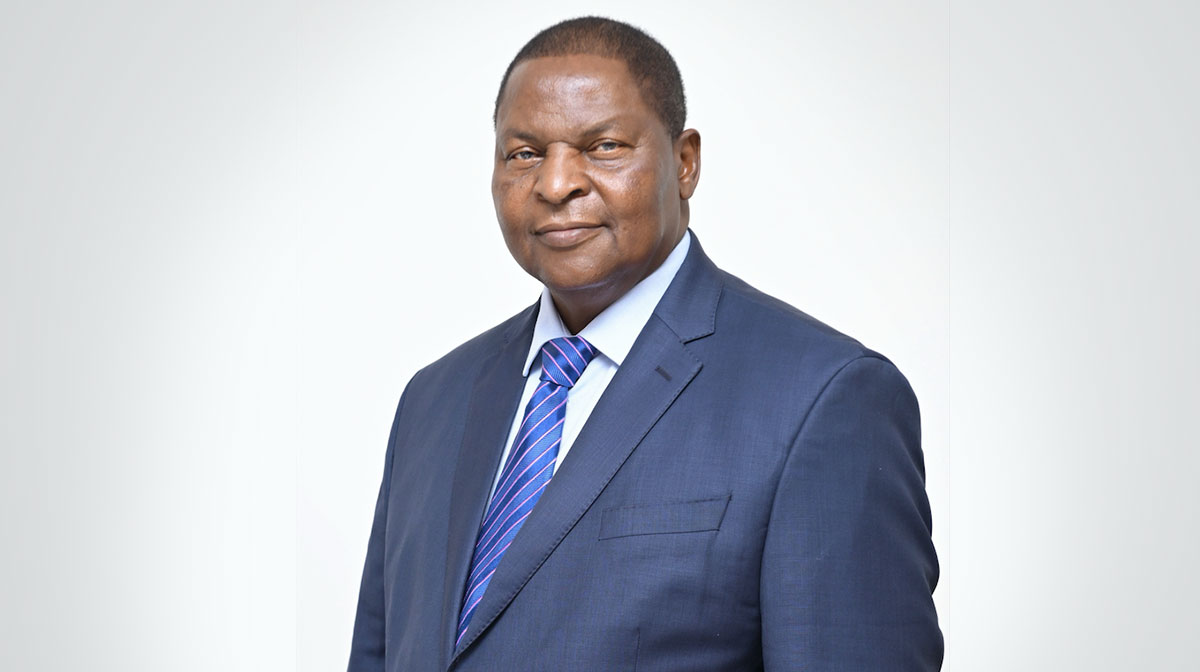
28 Nov Interview with Faustin-Archange Touadéra, President of the Central African Republic
The Central African Republic stands at a pivotal moment in its development: under your leadership, the country is opening to the world, advancing strategic reforms and positioning itself as a land of opportunity. How would you characterize the current state of the republic’s economy and the potential the country holds today? What makes this moment a turning point for the Central African Republic?
I’m really grateful for this chance to talk about the Central African Republic, its new vision, the business opportunities it offers and the fact that, in 2025, there’s total peace in the republic. There have been efforts to reconcile the people after the country’s crisis and we’re cooperating with major financial institutions, including the International Monetary Fund, the World Bank and the African Development Bank, which are supporting many of our current projects.
Very recently, we developed and implemented a national development plan for the period 2024-2028 that includes all the reforms we need to introduce, and the government’s priority programs for this five-year period. Recently, in Casablanca, this program was presented to potential investors, from which we were able to raise more than $9 billion. We’re currently working to mobilize these announced resources in several of our established priority areas, particularly human capital and productive sectors, such as mining, agriculture, water, forests and many others.
The Central African Republic has a lot of potential that needs to be developed. You can see that in the mining sector, for example, where we are a country that still has a substantial potential. We have more than 470 mining indices: gold and diamonds are our main resources, but there are many other strategic resources such as cobalt, platinum and other rare earth elements, as well as uranium and oil. For investors, these are areas in which those who are interested can come and invest this year.
We’ve implemented major reforms to improve the business climate to work in such a way as to make our economy attractive to foreign capital, encouraging investment here in the Central African Republic. We’ve implemented reforms in taxation, customs duties and other areas, for instance. We’ve also created conditions to promote our banking system and, as we are in the Economic and Monetary Community of Central Africa (CEMAC) sub-region, we’ve put in place measures to facilitate regional transactions.
I mentioned mining as an area with potential, but there’s also agriculture. We have 37 million acres of arable land, of which I think only 3% is currently being farmed. So, there’s potential for industrial agriculture, especially since the country has good rainfall and plenty of sunshine. We’re in a tropical zone with a tropical climate and all the best conditions for truly industrial agriculture.
Tourism is another sector with many opportunities. For example, I came back yesterday from the town of Bayanga, toward the south of the republic. There’s a wonderful World Heritage Site near there that’s unique in the world called Dzanga-Sangha, where more than 200 elephants can be seen. It’s wonderful and a really amazing place for people to visit. We’re going to create the conditions to make it easier for people to visit this site.
We’re also working on our access routes. Soon, we will open Corridor 13, which goes to the deep-water Pointe Noire port in the Republic of the Congo. In addition, we’ve tried to improve and rehabilitate the road that leads to Douala in Cameroon to provide better access to the sea, since we are a landlocked country. We’re also working on our airport. As we’re landlocked, we need transportation services that enable everyone who comes here to leave or arrive easily.
One of the great things we have been able to do is to establish security and the authority of the state across the entire country, which helps provide guarantees to our investors.
The Central African Republic and the US have been strengthening their cooperation, with a recent business summit in Luanda announcing more than $2.5 billion in new commitments between US and African partners. How do you view the current relationship between the two countries and what opportunities for deeper collaboration do you foresee over the next five to 10 years?
First of all, I would like to say that the US is one of our major partners, financing security issues in particular — for instance, it is the leading donor supporting MINUSCA, the United Nations multidimensional stabilization mission here. We also exchange ambassadors, so there’s a good diplomatic relationship between the US and the Central African Republic. We really want to strengthen this cooperation. Very recently, our Minister of Foreign Affairs meet with the US authorities, and we’ve made a request for this to happen again in order to discuss the issues that really affect our direct relations.
We’re very open and very interested in cooperating with the US. And we’re going to take advantage of the announcement that was made in Luanda regarding US-Africa cooperation. We’re currently preparing for utilizing this in order to improve our economy.
This fall, the Central African Republic secured billions in new commitments for its national development plan and became the 46th member of the Africa Finance Corporation — strong indicators of rising confidence in the country’s potential. What makes the Central African Republic a particularly attractive environment for foreign capital today, and what measures is your administration implementing to improve the business environment for both local and international entrepreneurs?
As I already mentioned, we’ve done a lot of work to improve the business climate. Currently, we’re working on investment security. We’ve made reforms in this area and are now working on the legal aspects to provide legal protection for investments here. We’re also moving toward capping the damages that can be claimed from companies — because in the past, when there were small lawsuits, huge amounts of compensation were demanded from dismissed employees. We’re going to cap all this so that companies have sufficient margins. We’re also going to work to improve cash flow, meaning that companies can operate here and then repatriate their resources in accordance with the terms and conditions that apply in our sub-region. There are many elements in our reforms that will encourage American and other foreign investors to come to the Central African Republic.
The Central African Republic is actively strengthening its place in the regional economy, integrating into African Continental Free Trade Area (AfCFTA) markets and enhancing its continental presence. Hosting the African Caucus in the capital Bangui for the first time in 2025 marked a milestone in this engagement. How do regional integration initiatives support the country’s development strategy?
AfCFTA is a major initiative that the Central African Republic signed up to and has already ratified. It’s an opportunity to expand the African market and, for us, to promote trade between African countries. It’s a great opportunity for the Central African Republic, a landlocked country with products to trade. In agriculture, mining, culture and more, there are many things we can bring to market and to this African free trade area.
At the regional level, we’re members of CEMAC, which is governed through agreements, and we participate in the management of major economic decisions that we make together with the five other CEMAC states. In addition, we’re members of the Economic Community of Central African States (CEEAC), which also deals with political and internal security issues.
So, the Central African Republic is very involved and actively participates in regional and African cooperation. We’re very open with all our neighboring countries. There are no problems and no conflicts — on the contrary, we have very good relations. All the more reason for investment partners to come here and even work across borders with neighboring countries.
The Central African Republic experienced some turbulent times in the past. Yet, under your leadership, the state has restored calm and progressed toward lasting peace. In your view, what has been most critical in maintaining this stability and how do you evaluate its impact on the republic’s long-term development?
To restore peace, we signed an agreement with all stakeholders, including armed groups. 11 of the 14 armed groups that existed have now disbanded. Their members have returned to society. The other three groups have just signed an agreement with us, so you can see that the security conditions for reconciliation and social cohesion are in place.
At the moment, we’re in a pre-electoral period, with Central Africans preparing to democratically choose their next leaders at all levels, including the president of the republic, representatives in parliament, local government mayors and municipal leaders. So, the country is undergoing restructuring and enjoying a vibrant democratic life. Therefore, the Central African Republic offers a favorable climate for investment — we’ve never achieved such a high level of security, capacity or investment opportunities as we have today.
I believe that businesspeople need to come and take advantage of the fact that the land belongs to its original occupants. It’s time for American investors, in particular, to come here and invest in key sectors, such as energy, which we’ve really worked on, as well as services, infrastructure and telecommunications. When I was at the United Nations General Assembly in September, I spoke with SpaceX’s telecoms company Starlink. Executives from Starlink are going to come here soon to further discuss telecommunications, satellite technology and other areas. These are all opportunities available to American companies.
President Touadéra, your presidency since 2016 is marked by a steady hand, guiding the Central African Republic toward an era of national stability and development. What is your vision for securing the nation’s lasting progress if you are reelected on December 28, 2025 to serve another term?
These elections are crucial for the development of the Central African Republic. We’ve provided a truly democratic foundation for the republic — for the previous 40 years, there were no local elections. That means that mayors and other local leaders were appointed by the central government. I realized that this does not allow democracy to reach the grassroots level. In my opinion, there needs to be accountability in local government, which means these officials should be elected by their communities. That way, they have the opportunity to be accountable to them. That’s a major factor in the context of these combined elections: local, municipal and regional elections, legislative elections for deputies and the presidential election will take place at the same time.
The die is truly cast and this is obviously a crucial moment. We, as a government, will do everything in our power to enable the National Electoral Authority — which is the body responsible for organizing elections — to prepare properly and ensure that this is a period in which the Central African Republic emerges stronger.
These are decisions that show that peace is here, that democracy is taking root and that respect for justice and rights, especially human rights, is truly visible in the Central African Republic.
If I am elected, I will continue with our national development plan, because it was developed in a participatory manner. We sought input from all sectors of activity and all stakeholders — the private sector, civil society, everyone contributed to the definition of this plan. Because the project is very large, we established priorities, namely human capital, strengthening peace and security, working on basic social sectors such as education and health, and on productive sectors like mining, infrastructure, energy and others, in which many projects have been presented to investors.
I am focusing on this to define my vision for society. If I am elected, I will continue what we have already started, which seems to be working well and is supported by the international community.
Mr. President, after everything we have discussed, it’s clear that you are a central figure in the country’s modern history. Looking back, what achievements are you personally most proud of?
I’m most proud of ushering in peace and national reconciliation. It was an action that the entire population approved of and is now experiencing. Today, the population feels reassured and is happy. In the past, the country was completely divided but that is no longer the case. Religious communities really do live in harmony. Of course, we will continue to work on a number of issues, including health, education and so on, in a spirit of peace and social cohesion.
It has not been easy, but we’ve managed to achieve these advances thanks to the support of the international community. We did not do this alone.
Looking to the future, how would you like the Central African Republic to be seen on the international stage andwhat message would you like to send to readers potential investors?
The bad image of the Central African Republic that people might have gained from the press or social media is no longer the reality. The Central African Republic is a country with a bright future, a country where life will be good, where people will live in complete safety and confidence. Because there is harmony between communities and peace has returned. We have an administration that is growing stronger and stronger and that really wants to attract investors, as we lack internal capital. Foreign investors give us the means to create wealth and employment.
We are a country that is open and wants to cooperate with all other countries. One that does not limit itself to cooperation but is open and is currently searching for its identity. It’s true that we are a fragile country, but we’re aware of our fragility and we are a resilient people who have truly demonstrated our capabilities. Other countries didn’t think we would come out of what we have been through, but today there is peace, people are smiling, they are working. We have challenges but we’re counting on investors to help us overcome these challenges together. The Central African people are a proud people.